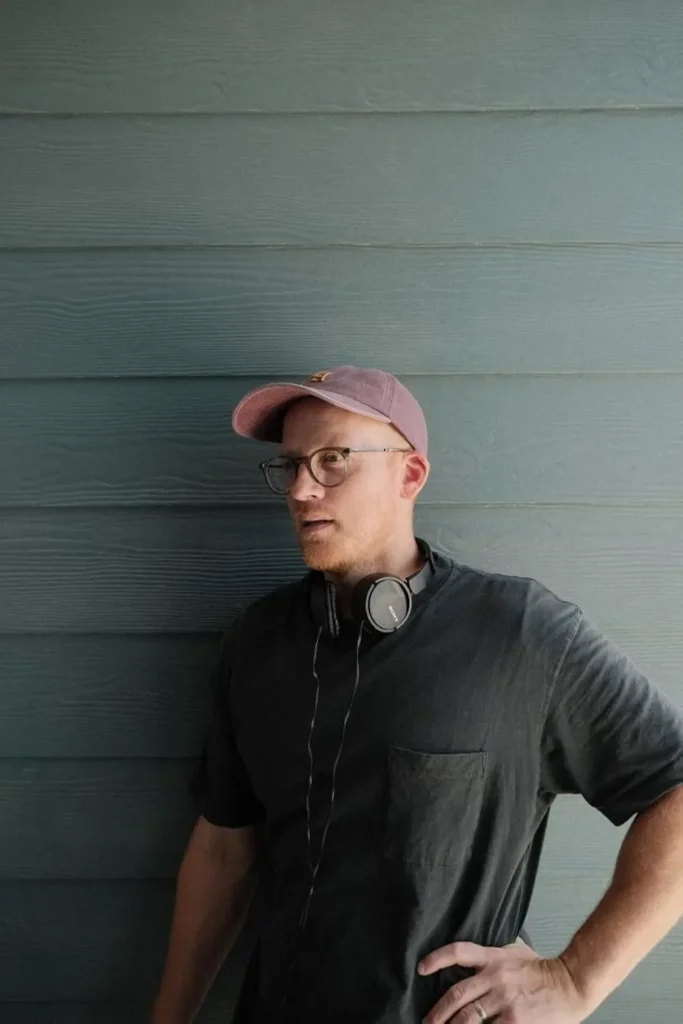
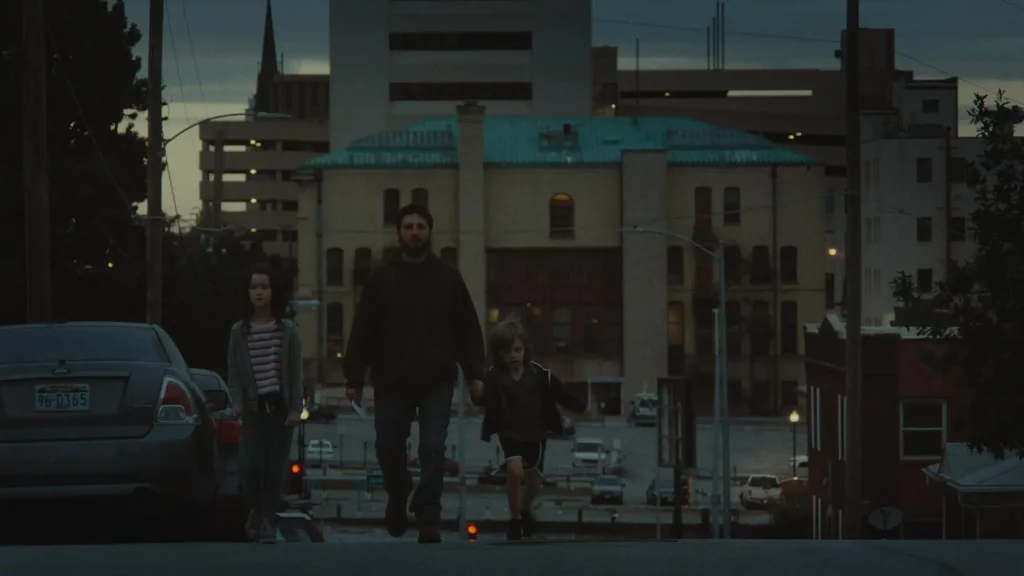
OMAHA is an exercise in empathy, taking a single father (John Magaro), his two young children (Molly Belle Wright and Wyatt Solis), and the family dog on a road trip across the American West during the 2008 recession. Through the children’s eyes, Dad is acting rather strangely, and the destination (and purpose for going there) remains uncertain. Helming this sensitive family drama, filmed with child actors, an animal, moving vehicles, and multi-state locations (Utah, Wyoming, and Nebraska), is director COLE WEBLEY.
Father-of-four Webley connected with Robert Machoian’s screenplay for Omaha and leaned on his vast experience as a director of short-form content to make the film his feature directorial debut. Before Omaha, Webley directed numerous TV commercials (including a Super Bowl spot for New York Life), winning a Clio Lion Award and AICP’s Advertising Excellence Award. He also directed short films, including 2011’s Birdland, 2016’s Con Amor, and 2022’s Dark Blue.
Omaha premiered at the 2025 Sundance Film Festival before going on a hugely successful festival tour. The film has screened in Argentina, Australia, Brazil, Canada, France, Germany, Greece, Ireland, the Netherlands, Poland, South Korea, Spain, and Sweden, winning Jury Prizes at the Deauville American Film Festival, Dallas International Film Festival, Hamptons International Film Festival, and more. Greenwich Entertainment will release Omaha in New York theaters on April 24, before expanding to additional cities nationwide in May.
We spoke with Omaha director Cole Webley about how he brought his road trip drama to fruition.
__
COLIN McCORMACK: How did the screenplay for Omaha first end up in your hands?
COLE WEBLEY: Robert Machoian, the great writer, had a film at Sundance that I was smitten by called The Killing of Two Lovers. And I realized he was my friendly Utah neighbor who lived an hour away. I went up, grabbed him by the lapels, and said, “We’re going to be friends.” And it worked out. We were collaborating on another script, and I said, “Robert, do you have anything else that you’ve written? I love your writing.” And he slipped me this movie called Nebraska, which dates it; he had written this before Alexander Payne’s movie. I loved it, and I knew immediately that what I was reading on the page was meant to be a movie. I remember thinking, Holy cow, whoever makes this is going to have a great film on their hands. That’s how naive I was that it was going to be me.
I sent it to my producer [Preston Lee]. He immediately read it and wrote back, “I think this is your first movie.” It was almost like getting slapped in the face; it was so obvious, and I didn’t see it. Then I took the script on and read it multiple times as the filmmaker instead of an audience member, and I started to see in it everything that I wanted to do, and why I love films. That movie was so well-written. We did some adjustments to the ending, but it was truly ready to go. I got it in March, and we were shooting in September.
CM: Outside of the specifics of that script, were there big picture aspects of feature directing that you were really looking forward to flexing as a new muscle?
CW: The truth is, I had only ever thought I would direct movies. My third year of film school, I got wrangled into this commercial directing class, and suddenly that became a real avenue to solidify a safe structure. I had two kids by then. Cut to a decade and a half later, and I had this great and stable career in commercials, but I hadn’t made my movie yet. I had made eight short films, and I was kind of done with that format. So, right around when COVID hit, we were gearing up to make that leap. I’m glad it came later in my career as a director, and that I found the script that I really feel was meant to be my first film. That step to features was very comfortable to me. I felt at home.
CM: Given your experience on so many sets, was there anything that still took you by surprise once you were in the thick of directing a feature?
CW: No, just the edit. I had cut hundreds of commercials, and you know by day five what you have. You don’t know what movie you have for four to six weeks. Going into my second film, I’ll be a lot more patient with myself. We were rushing, and we were not sure if we were going to try to submit to Sundance 2024. We were just on the cusp, and we had three weeks. So we thought, Maybe we’ll rush a cut in three weeks and send in a rough cut. And I remember at the end of those three weeks, I loved every scene, but then I was watching the movie, and I just couldn’t find my voice in it. I was like, “Why is this not working?” And the simple answer is, I just didn’t know what the movie was yet.
You can have a script as clear and as beautiful as Robert’s was, and still, in an edit experience, have this transcendent moment where you [realize], This is what the movie is. That’s what happened with me. It was a learning curve of being patient and letting yourself really, really find the movie. Which we did, eventually.
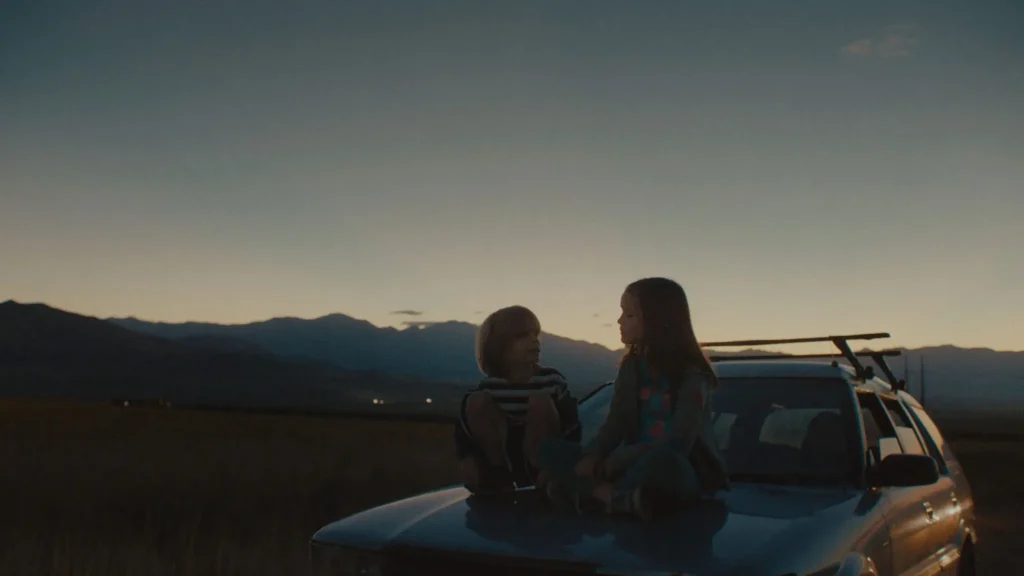
CM: You had a lot on your plate, with multiple states, many locations, children, an animal, a moving car. How did you and your producers wrangle everything to be able to do it as a first feature in the time crunch and budget crunch that you had?
CW: It was a great production team, great producers, and a great lead producer in Preston Lee. And, it was experience. My DP [Paul Meyers] and I have spent hundreds and hundreds of hours on sets for — between the two of us — several decades. It was about knowing, Okay, you’ve got four hours with Wyatt. You’ve got six hours with Molly. We had an incredible studio teacher [Bettina Russo] who was a part of our process, and she was there as a co-member of this production. A lot of times, as filmmakers, we see these limitations as obstacles, and some people wear that as a badge. Everybody’s a bad guy except for me. And that wasn’t the case. We all knew that I wanted these kids to walk away with an experience that they would remember with pleasure for their whole lives. There was a perfect balance of: We’re here to make a movie; the kids have to go to school; and the kids have certain hours. All those things coalesced into this beautiful experience. It was like a summer camp where they got to come and make an incredible movie and do their schooling.
It was awesome, and it was very difficult at the same time. Even if Wyatt had four hours every day, his attention span was not acute for that much time. So, you really only have two to three hours of him where he was solid. And the rest, it was a little unhinged [laughs]. Molly was great; she could have done tens, but she’s not allowed to. She’s well beyond her years. And the dog was pretty easy.
But, it was a lot to bite off for a first movie. I’m glad we were a little naive to that because when we were in production on very well-funded commercials, you can throw money at problems. On this, you couldn’t. It was a lot of pivoting, and thankfully, we had all that experience where I knew what I wanted and how to get it on set. We weren’t wasting time trying to figure out where the frame was. Paul and I had done a ton of prep. So it was fun, but it was very hard. I definitely don’t want to jump into that again on my next movie.
CM: In terms of casting the children, outside of acting talent or what they can deliver in an audition or a self-tape, what other considerations are you looking for when you’re casting a child actor that maybe are different from casting an adult actor?
CW: That’s a great question, and I think that sometimes those two things actually overlap more than we think. I’m always looking for a child to not be trying to please the adults in the room. That’s kind of how they’ve been rewarded for their efforts. Oh, you did a great job there. What did you do? You pursed your lips, or you did a little eye thing, and someone really loved it one time, so you’re repeating that.
With Molly and Wyatt, I was looking for a rawness, a comfort with the unknown and uncertainty, and with rolling and the punches. And also trust. It was upon me to build up that trust. There were some things that, with any child actor, you have to kind of strip away. They were both just so great, from their casting tape on. I also looked at who their parents were. How are they going to be working alongside on this journey? We couldn’t have gotten luckier. Both sets of parents were amazing people, are now close dear friends, and will be forever. It was a beautiful experience in that way.
CM: The father character carries so much weight. How did you end up getting John Magaro to sign on?
CW: I loved John, and I knew this film was make-or-break by who the dad was. I knew that he could be neither villain nor hero, and had to be an everyman. John encompasses that to a T. It wasn’t until I saw him as Cookie in First Cow that I was like, He has such a tenderness to him. He’s always had it, but now we’re seeing it in these roles in Omaha, First Cow, September 5, and, of course, Past Lives. He has a special ability to be an everyday man, but then when you really get the camera on him, he transcends into this leading man with such gravitas and power.
John had, incidentally, made a movie with a good undergrad film school friend of mine, and I didn’t know that. I went to offer him the movie and realized he had a movie coming out by my friend. I was flabbergasted and texted my friend, “I’m sending John this script. Will you tell him to look for it?” And, I am quite friendly with Christopher Blauvelt, the great cinematographer of Kelly Reichardt’s movies and beyond. We’ve shot commercials together. So, Blauvelt texted John and said the same thing. The script arrived through another writer friend, Samm Hodges.
It’s just the luck of having worked in commercials long enough, where you run into people who know people who know people. And that actor circle is quite small, I’m learning. I wanted John, and just said, “Please.” Because I knew if John did it, I was going to be in great hands with who this man was and how affectionately we felt for him, how angry we would be with him, et cetera. John read it, we did a Zoom, and he said, “I’m in. Let’s figure this out.”
CM: As you’ve screened the film around the world, has the reaction largely been what you were hoping for from the moment that you read the script?
CW: I didn’t know what to expect. I did know that it would be an emotional wallop. Maybe I didn’t expect it to be so transcendent, whether you experienced a moment like that in your life or if you had a loving father. I had a guy come up to me, and he said, “My dad’s a single dad, and he used to take us on these road trips. This movie is so powerful to me because I see my dad in that man, just trying to help us have a good time.” It wasn’t like he had this trauma or whatever; he was just like, “I love my dad.” Wow, I didn’t anticipate that. Then, I had this adolescent or twentysomething who couldn’t talk to me after Sundance. She was so sad and distraught, but moved. The most she got out was, “I’m estranged from my father, and I felt like I was Molly the whole time.” And I knew that would come. It’s tough for moms to watch the film, I think. The dads in the room, which is who I was hoping to connect with, I think they’re having a good go at it, too.
CM: What’s next for you that you’re excited about?
CW: I’m so excited to get Omaha out because I get to finally tell people where they can watch it or rent it. And I’m working with an incredible producer named John Fox on a picture that we’re putting together. We’re out to some pretty great talent right now. It’s a drama based on some of the things of my youth with farming. I grew up in rural Washington as the son of a farmer, and corporate farming is changing the way of life for so many of these folks. And there’s a great script that was passed to me that I love, and we’re running up the hill to see if we can make that thing next.
CM: And you have some lessons that you’ll be taking with you that you learned on Omaha?
CW: No dogs, no kids under eight, don’t shoot on a boat or in a car. No [laughs]. Let’s say it’s a bigger bite of the pie story-wise and character-wise. I keep saying I just want to shoot scenes with some adults talking. I only got to do one of those scenes in Omaha. The next movie will be a lot of that.

__
Thanks to Cole for talking to us about OMAHA. Learn more about the film at omaha.film.
This interview has been edited for clarity.
If you’re an independent filmmaker or know of an independent film-related topic we should write about, email blogadmin@sagindie.org for consideration.