AMY LANDECKER has acted in some of the most critically-acclaimed and transformative TV series of this century, including Mad Men, Curb Your Enthusiasm, Louie, The Handmaid’s Tale, and a SAG Award-nominated role on Transparent. Her film work has included mainstream studio fare (Dan in Real Life, Doctor Strange), indies from new voices (Shithouse, I Wish You All the Best), and celebrated titles from auteur filmmakers (The Coen Brothers’ A Serious Man, Nicole Holofcener’s Enough Said, Miguel Arteta’s Beatriz at Dinner), in addition to an abundance of voiceover work (Assassin’s Creed, Trollhunters). Landecker moved behind the camera in 2019 with the short film Tired, which she wrote and directed, before delving into feature filmmaking with the new romantic comedy FOR WORSE.
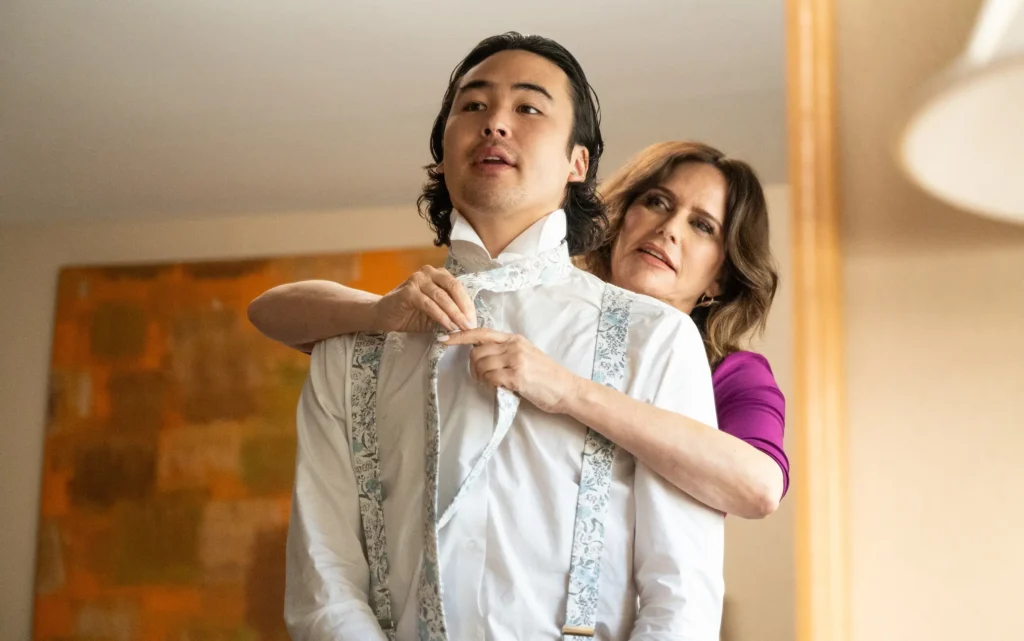
For Worse finds Lauren (Landecker) expanding her horizons post-divorce via an acting class, befriending a group of classmates half her age, and eventually heading to a destination wedding weekend with her new crew. Landecker surrounds herself with an ensemble cast including young talents like Nico Hiraga, Claudia Sulewski, and Kiersey Clemons, alongside screen veterans Missi Pyle, Ken Marino, Simon Helberg, Gaby Hoffmann, and Landecker’s husband/fellow producer Bradley Whitford (cheekily given an “and introducing” credit in the film).
For Worse premiered at the 2025 SXSW Film Festival, before going on to an award-winning festival run, including the San Diego International Film Festival (where it won Best Comedy) and Wisconsin Film Festival (where it won the Audience Award for Best Narrative Feature). Brainstorm Media will release For Worse in New York and Los Angeles theaters on February 27, before expanding to additional cities on March 6.
We spoke with Amy Landecker about her experience making her feature directorial debut, and her array of inspirations – from Paul Giamatti to the Duplass Brothers to stand-up comedy.
__
COLIN McCORMACK: To begin, when did you start to write?
AMY LANDECKER: I had no idea I was a writer at all until I was around 40. I was going through a divorce, and that brought up stuff that I had never processed, like separation anxiety, sharing my daughter with another person, and someone new having an opinion about my parenting. I was working on All is Bright, this very cute indie Christmas movie. It was me, Sally Hawkins, Paul Rudd, and Paul Giamatti, and I thought my whole life was going to change. And it didn’t quite, but it was still a beautiful experience, and I couldn’t believe I was with that cast.
CM: Yeah, there are worse people to make a movie with.
AL: It was beyond. Paul Giamatti was with me one day when I got a particularly distressing email criticizing me, I think from my ex’s girlfriend. And I had a meltdown on set. I was crying, and I read Paul the email. It was sort of funny in the way that it was communicated, and he said, “You should write this shit down because this is hysterical.” So, I came back to LA and coincidentally, my friend Fielding Edlow, who’s a stand-up and writer, said, “I’m going to be assisting this comedy writing class. Would you want to take it? You end up doing stand-up at the end.” And I was like, “Yeah, I guess I do.” I needed a channel.
I did the stand-up, which I never thought I would do, and it went really well. It touched a nerve. If I can get crass, one of the jokes was something along the lines of, “If you got divorced and you don’t have kids, I don’t want to hear about it. That’s just a breakup. Divorce is arguing with your husband while his girlfriend gives him a blowjob and braids your daughter’s hair.” Something weird like that [laughs].
CM: [Laughs] I like it.
AL: My friend had recorded it, so I got a tape of it. My friend Julie Golden, who’s a stand-up, said, “That was really funny. You should find a producer and pitch it as a TV show.” I had come to LA for a sitcom that got canceled after two weeks, so I was just an actor trying to figure out what the hell I was doing. Then I got a tiny part in Enough Said, which Nicole Holofcener was directing. And I sent her the tape of the stand-up and said, “Would you want to develop a show with me about this?” And she said yes! We called it Angry MILF, about a single voiceover [actor] who was getting divorced. We sold it in a development deal to FX the same day I booked Transparent. But in a collective consciousness moment, Pamela Adlon came in to FX [with Better Things] and was like, “I want to do a show about a single voiceover [actor] in LA.”
At that point, I was already on a show and was very happy, but it showed me that I could write. I could sell an idea. And get paid to write. It was crazy. I did the same thing with a show at Amazon, and I wrote another script with the Duplass Brothers. Nothing ever got made, which I found out is very common in Los Angeles, but I never minded because I was terrified to actually make the thing. I was not Pamela Adlon; I was not ready to do it. I was so overwhelmed.
CM: What inspired you to write For Worse?
AL: I love wedding movies and rom-coms. I went to a wedding, and I behaved very badly. No one cared or noticed, because everyone’s drunk at a wedding, but I came home like, Who was that? And it was so funny. I immediately thought, “There’s a movie in here.” I first made it as a very dark short film [Tired], and I hated how depressing it was. In my own life, I had such a lovely landing. I wanted to give people hope that you can go through massively dark times and you’re going to be okay. That’s the story I wanted to tell. I don’t want to tell the story of how I fell apart; I want to tell the story about how your friends and love can pull you through, and how you can forgive yourself.
I had financiers who pulled out, and it was the only time I wasn’t relieved. I fell apart. So, then I knew: You really want to make this. Jay Duplass, my brother on Transparent and one of my closest friends and a mentor, said, “You can do this as a SAG Ultra Low Budget.” I talked to some line producers who were like, “No, you can’t.” But that was the only option I had. So, we figured out a way to make it work. Most of that was only having 11 shoot days. The way I got away with that is because if you have brilliant friends like Gaby Hoffmann and Ken Marino and Missi Pyle willing to drop in some of their talent — even for a day — and producers who beg, borrow, and steal, you can pull it off. Jay is the one who said, “Anything is possible when you make your own stuff.”
CM: The Duplass Brothers know the most about that.
AL: They’re so good at it.
CM: You have all this experience on these different sets. Once you showed up on that first day as a director, was there still something that completely surprised you about what that job entailed?
AL: I was surprised by how easy it was. I was terrified to do all three [act, write, direct]. Literally, I started therapy to get my body in order. I should not do all three things. I should let someone else direct or let someone else act. The people closest to me said, “No, you need to do it all.” Jay said, “This is your story.” I wrote it for me; I knew it inside and out. We’ll have to move quickly, so I need someone who knows exactly what I want. And that would be me, right? But I was worried until we started. Then I thought, Oh, this is easy. I felt a real joy and ease that I had not anticipated. If I just had the director’s eye, there are things visually that I would have done differently, in terms of filmmaking, but it was pretty great considering the timing. I actually think my acting is better when I’m doing something else because I can’t think about it.
CM: For an actor/director in post-production, you’re shaping a film while also having your own performance as a part of the editing process. How was that for you?
AL: I hope this doesn’t sound egotistical, because I’m the last person who likes my work, but I thought I was going to hate editing and seeing myself, but I really was happy with what I was doing. It was very relaxed, and I could feel that I was in the moment with all these people, and it was really about them. I mean, did I like the way my neck looked? No. But you get over it after a while. [Post-production] was a surprise to me, because I never look at myself when I’m an actor. I never look at the monitor, I never look at dailies, I won’t even look in the mirror in the bathroom after I’m out of hair and makeup. Because I want to stay in a place of performance and not ego. On this, I didn’t have time for that. We had to move.
CM: Are there any memorable scenes or shoot days where you really had to pivot and change direction?
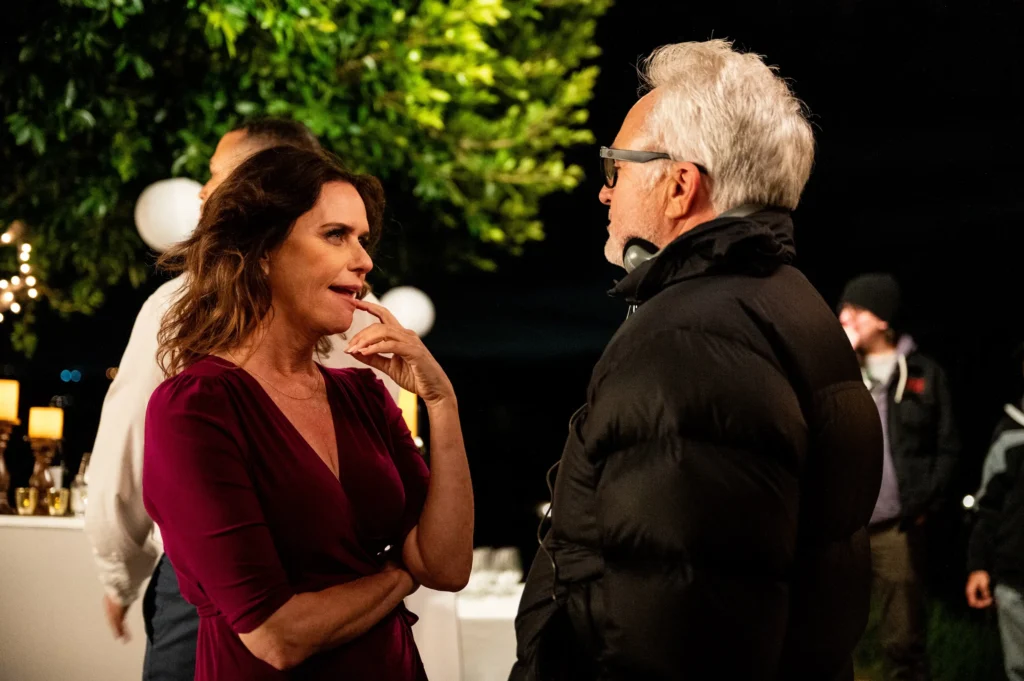
AL: Oh my God, the wedding. We had a torrential downpour. We were shooting outside, and we couldn’t even safely put a tent up because the winds were so strong. There was nothing to do but wait it out. There’s this whole scene where people are giving toasts, and we couldn’t turn around on the day. So one day we had done the toasts, and then the next day we had to squeeze in the reactions to the toast while we were doing other stuff. I’m literally in a scene yelling across to the other side, “Okay, he said something sentimental!”
Then we had an editor, Jason Gallagher, who was brilliant enough to pull reactions from other places, combing through all the footage and piecing things together. I didn’t get what I wanted of the daughter reacting directly to her father, so we had to find something like it. I wish we could have gotten a wide on the cake fall. We just couldn’t. So, with editing and sound effects and different cuts, you’re pretending you’re seeing something that we never got on camera. I did this big monologue meltdown in one take. Done, hope it’s good, that was it.
CM: You didn’t make things easy for yourself.
AL: We lost the time that we needed; we just did. There was nothing to do but run and gun and hope for the best. And it’s funny because the wedding turned out really well, and people love it. It’s one of their favorite parts. People don’t realize all the magic that can be done in post, like ADR. I’m really good at voiceover, and I do a lot of voice matching. So I did almost everybody’s ADR. That was fun.
CM: So, you made it through this unscathed, with some new skills. Do you have the bug now for continuing down the writing and directing path?
AL: Writing is really hard, but I definitely still love it. It’s very therapeutic. I will only take a directing job if I feel like I have something to bring to it. There are some things I don’t do very well, and some things I think I do well. I feel like I can get really good, funny stuff out of funny people. And so, I did just recently get attached to direct a script, and we’re having a workshop with the two women writers. It’s a genre movie, and it’s the kind of stuff that I loved growing up. It’s on a much bigger scale. I’d love to [direct] episodic television, because everything’s already set up. I’m also in the mix for an acting job. I always thought, Maybe there won’t be that much available now that I’m older, but every once in a while, something comes along. Thankfully, I still have options as a fiftysomething [coughs] year-old woman.

__
Thanks to Amy for talking to us about FOR WORSE. Find out more info about the film at forworsemovie.com.
This interview has been edited for length and clarity.
If you’re an independent filmmaker or know of an independent film-related topic we should write about, email blogadmin@sagindie.org for consideration.