

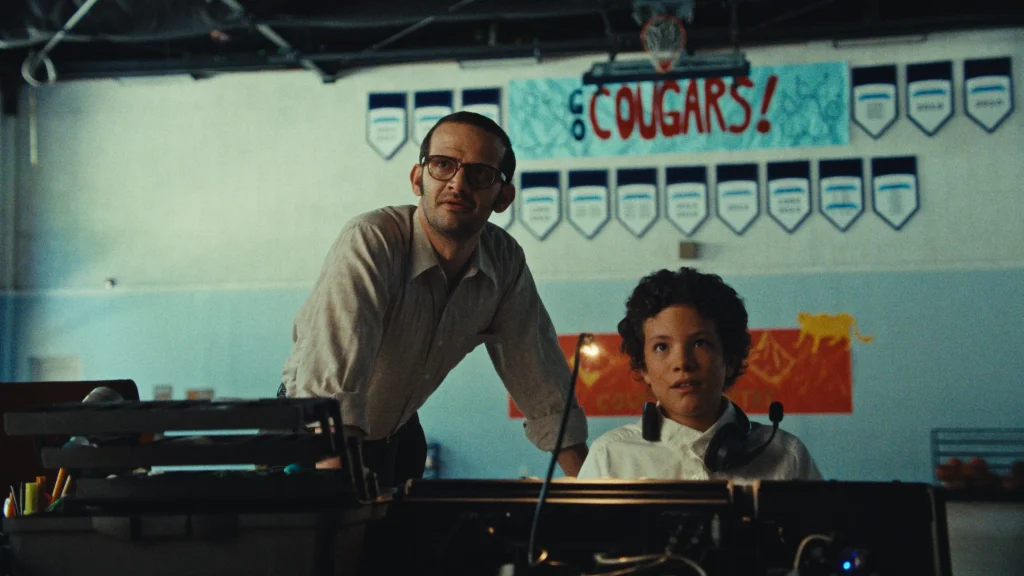
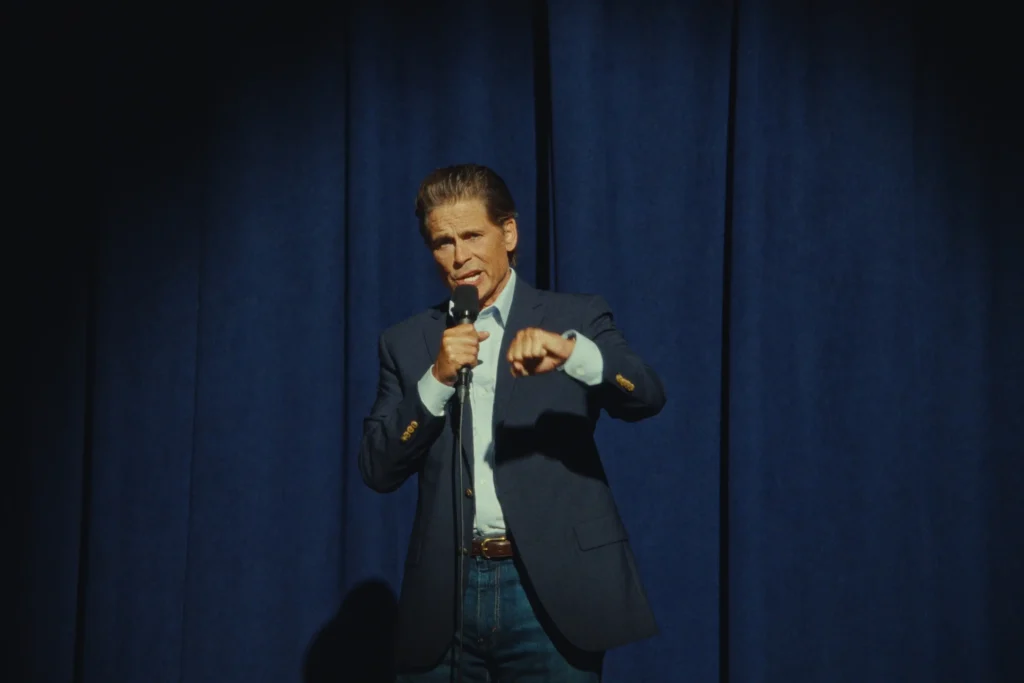
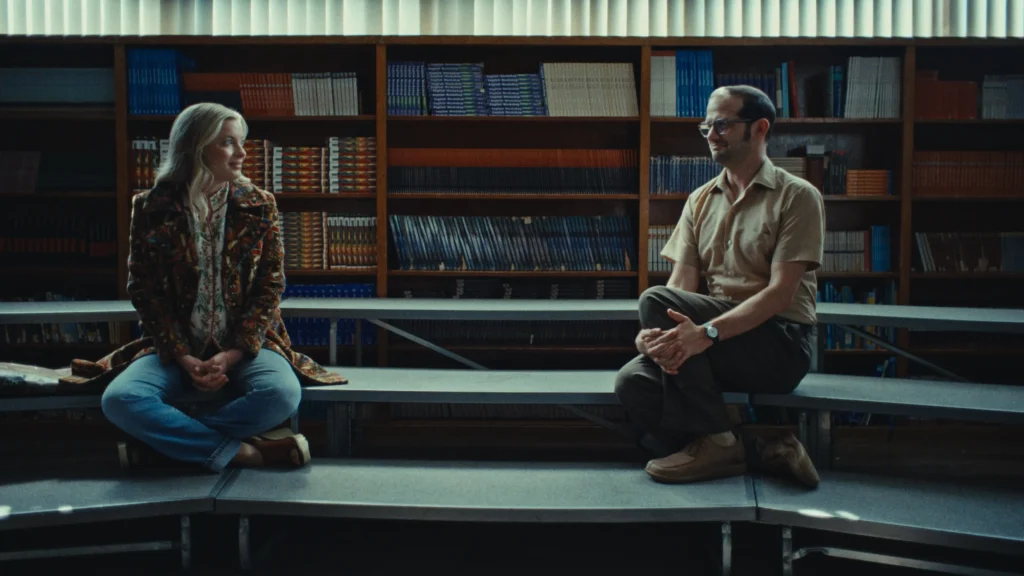
An off-the-rails production, a power-mad director, a nosy producer, childish actors. Thankfully, for filmmaker GISELLE BONILLA, all of this drama occurs on-screen in her feature debut THE MUSICAL. But as we learned talking to the director/producer, things weren’t always easy behind the scenes of the dark comedy either. The Musical follows a middle school drama teacher (Will Brill), recently dumped by his co-worker (Gillian Jacobs), as he sets out on a mission of revenge against his boss/romantic rival (Rob Lowe, who also produced) by sabotaging the school play.
Bonilla earned her BFA from NYU’s Tisch School of the Arts and her MFA in Directing from the American Film Institute. Before that, she was a young actor in films including Richard LaGravenese’s Freedom Writers and Charles S. Dutton’s The Obama Effect, and TV series such as Workaholics and Grey’s Anatomy. As a fledgling filmmaker, Bonilla was named a Latino Film Institute/Netflix Inclusion Fellow, Telluride Film Festival FilmLAB Fellow, and Sundance Institute Ignite/Adobe Fellow.
Bonilla’s NYU thesis film, Virgencita, won the Horizon Award at the 2018 Sundance Film Festival. Her AFI thesis, The Bullfighter, won the Directors Guild of America’s Student Grand Prize Award and AFI’s Richard P. Rogers Spirit of Excellence Award. The Musical began life as a short film at AFI, which went on to win the Audience Award at the 2024 PROOF Film Festival. Following that success, Bonilla got to work on the feature adaptation (written by her co-writer on the short, Alexander Heller). The feature premiered at the 2026 Sundance Film Festival.
Coming off its independent theatrical run (via Unapologetic Projects, Variance Films, and Blue Harbor Entertainment), The Musical will arrive on VOD platforms on October 20. We spoke with the film’s director and executive producer Giselle Bonilla about the rollercoaster of getting her debut feature in the can and out into the world.
__
COLIN McCORMACK: Of all the shorts you made in film school, what was it about The Musical that stood out as something that you wanted to revisit and expand?
GISELLE BONILLA: I feel like spite is so universal, but it’s embarrassing to admit. So many of my decisions have been motivated by spite [laughs]. I kept revisiting that theme, especially when entering the industry. You naturally feel like an underdog. I also had such a great time working with my department heads on the short. It felt like you were making a movie with your friends in your backyard. It would be so amazing if we got to make our first feature together, which we all ended up doing.
CM: And you were able to tap into the AFI connections with your mentors, as well, to help get the film off the ground?
GB: Chris Schwartz is head of alumni relations at AFI. I asked him before I graduated, “Can you help me get a job in the industry? I don’t want to go back to bartending.” And Jonathan Levine, who was an AFI alum, had texted him that morning looking for an assistant. I immediately sent my resume, and within a few hours, we had a five-minute conversation and I was hired. It was my first job in the industry. I was the assistant for him and his producing partner, Gillian Bohrer, for two and a half years. When we found the financing [for The Musical], I asked them to come on as executive producers and help us make this a real movie. Within a week of having them on board, we got our cast. I owe it to that one connection. The fact that they were willing to help me and mentor me through my first feature was so generous. The movie quite literally would not be what it is without Jonathan and Gillian and my collaborators from AFI.

CM: From what I understand, it was a rocky road to getting your final cast in place.
GB: We had an actor who was supposed to play Principal Brady drop out ten days before the first day of production. Being an assistant, I texted all my assistant friends at every agency and asked them if they could help me find a replacement. My friend Chloe Janson slipped it to Rob Lowe’s agent’s assistant’s desk. By some miracle, he read it within a week. At that point, it was like, Whatever, we’re going to be fine. Let’s keep moving forward. Then, the woman who was supposed to be Abigail, the ex-girlfriend, her agents found out that our name actor was out, and they pulled her out of the movie.
So, now we’re five days out from production, and we’ve lost two of our three leads. The line producer says, “It’s over. We have to pull the plug and tell the crew tomorrow we’re shutting down.” All of our money in prep had been spent, and that had come from family and friends. It was very high stakes, having to confront these people who trusted us to make a movie with their money, and there was going to be no movie to show for it.
Then, Chloe texted me and said, “Rob read the script. He wants to meet you. Go drive to Santa Barbara right now to pitch him the movie.” I begged the producers not to tell the crew yet. Let me have this meeting and see what happens. Rob actually saved the movie.
CM: I would think by that point you had a polished pitch for the film, but this had very different stakes and pressure when you’re pitching Rob Lowe to try to save the movie. How did you get into the right mind space for that?
GB: I remember I showed up two hours early to our meeting, and I went for a walk along the beach. I really thought the movie was over, and a wave of calm came over me. I’m naturally a neurotic person, but I remember looking out at the bay, and there was a surfer there but no waves. This guy was waiting for nothing. I identified so hard with that sentiment. You’re going to wait out there even though you know nothing’s going to come, but there’s a chance something will, and it will have made this whole trip worth it. That’s how it felt, and it gave me this weird sense of calm under extreme duress.
I saw Rob, who is a very close talker, and he said, “You look pretty calm for somebody whose movie is falling apart!” I started laughing, and said, “I have this fantasy that I’m going to be in an editing suite, and it will have been played by who it was always meant to be played by.” And he just snapped and stood up and said, “That’s exactly right. When I was directing my first feature, all my actors dropped out.” Then he started a one-on-one education of 50 years of experience with shit hitting the fan. It was so enlightening to see somebody so passionate about filmmaking, who also gets a kick out of the impossible. It felt so romantic to see somebody still have so much love for the game and want to do something this low-budget and crazy. He’s hungry to keep taking risks.
He asked me how I see the film. I said, “I think it would be funny if School of Rock was shot with the severity of Apocalypse Now.” He said, “I’m in.” I don’t know why he trusted me as a first-time feature filmmaker, but it was the same sentiment that Jonathan Levine had in helping us put the project together. Rob came on as a producer, not just as Principal Brady, and he helped us find more money. Because of his attachment, I got to meet Gillian Jacobs the next day. She was an angel in human form. It was really a miracle. It was like we were making a movie in the backyard with our cousins… and Rob Lowe.
CM: With your original cast and original schedule, had you planned on having time for rehearsals? Did that get cut short because of the casting upheaval, or was it never on the table?
GB: I wish that we could have had rehearsal. I talked about this with Rob because he asked me a lot of questions about the kids. I said I didn’t want to hire polished child actors, and I asked him about the casting process for The Outsiders. [Francis Ford] Coppola had written a scene and they all played different characters, then switched. So they all got to step into each other’s shoes. In the callback session, it felt like a rehearsal where they got to build shared memories. Rob told me how meaningful that was as a child actor.
We were supposed to be a 25-day shoot, but we decided to be union in LA before we started. So, we went from 25 to 21 days. Then, as we were shooting, it became 19 days because the budget kept ballooning from union fees that would show up out of nowhere. It was quite overwhelming, and we were moving at a really fast pace. Even with 21 days, I insisted on having the callbacks with the kids in person.
With 30 children, we did a 6-hour day. The first two hours were choreography, the second two were improv games, and the last two were scene study where everyone memorized one page and they took turns playing each other’s characters. So, by the time the kids — who were all 10 or 11 — came on set, they had already gotten to know each other intimately in this summer camp-like environment. It pushed their chemistry so you believed these kids were in school together. They could simply sit comfortably and scratch their head and not feel like they had to perform polite niceties around each other. That’s how I cheated a fake rehearsal.
CM: I’m always curious about actors who become filmmakers and what the casting process is like for them when they’re finally on the other side of it.
GB: Casting is the saddest process, especially with putting together the final kids. The movie changes tone completely with a different person in it. So every time you decide someone’s going to be in this role, you kind of mourn the tone that could have been with this other awesome person in that role. That’s the most stressful and exhilarating part.
But then you’re on set. It was so amazing to be at the monitor every day with Alex Heller, who wrote the film. He would be laughing at his own jokes and smiling, and that’s when it would be like, Okay, I think this is really working. That’s the most rewarding thing ever, because you’re doubting the whole time internally but outwardly projecting, I’m confident about every decision I make. You never know how it’s going to work until you’re in the edit.
CM: On that first day on set, obviously, there’s a huge sigh of relief because the cast has been finalized and this thing is really happening. But on the other hand, you still have a movie to shoot. What was that first day like?
GB: I chose to start with the kids’ audition sequence because I knew there was going to be a natural stiffness to the first day on set. A lot of them had never been on a set before, so I didn’t want that culture shock to affect any of the meaty scenes. With the audition, if they’re stiff, it’ll work for the sequence. It was quite fun. We had loud music playing, and everyone was dancing and cheering each other on from behind the camera. They got to quickly see we’re supposed to be cheerleaders for each other and respect when somebody’s on stage. Will was there and was so supportive. He’s so great with every actor, and is always giving them 100%, even when he’s not on camera. He created a really safe environment for the kids, so I’m glad that was their introduction to him before he spent the rest of the shoot giving them awful lectures.
We got the school location for very cheap because we’d done a lot of AFI shorts there. But then they see us roll in with these union trucks, and they’re like, “Oh, this is a real set?” So they were a little annoyed and started to double-book us. Most of the movie takes place in the auditorium. I was shooting a scene with Rob, Will, and 13 kids, and then girls in volleyball shorts start squeaking into the auditorium. They just started setting up their net like, “We have a volleyball tournament.” So the producers are trying to wrangle what’s happening, and we’re getting every single shot we need of Rob and wrapping everything out of there so they can do their volleyball tournament. Then we’re coming back to that scene two weeks after when we have all the kids again. Every scene with Rob in the auditorium was shot weeks apart.
CM: There’s been such a big push to bring filming back to Los Angeles, and we’ve all heard horror stories of it being impossible or too cost-prohibitive to stay here. Was there any question of whether you would stay in Los Angeles and film here? Did you scout other areas?
GB: We didn’t scout, but we looked into states or countries for their tax benefits. I knew it had to be here because I wanted to bring the department heads from the short to the feature. That was not a discussion for me. I’m also from L.A. The city really inspires me. There was nothing funnier to me than a playwright who wants to be in New York but lives in Burbank. I wanted to infuse some of that banality of suburban Los Angeles into the film without L.A. being this character of superficiality. I wanted some of the bitterness to come through of being absolutely blasted by the sun every single day. Also, I don’t know that we would have gotten the cast we got, because it was such a small movie, if we hadn’t shot locally.
CM: Once you were in the edit, how delicate a balance was it to find the right tone between the comedy and the darkness?
GB: We never played for the comedy. The more serious [Will] was, the funnier it was to us. Will is so physically hilarious. He gave us everything, and we did so many variations. He went so goofy that there was a version of this film that is like Mr. Bean [laughs]. But the idea of shooting it as seriously as the character took himself informed a lot of the tonal decisions. With the score, what is he hearing in his head as he’s ruminating and simmering with spite? To me, it was orchestra. The way he was always observing and obsessing, it’s got to be long lenses and zooms to make it feel like a paranoid thriller. My DP [Tu Do] and I were laughing at a lot of our own visual jokes in composition, and if we think this is funny, hopefully someone else will too.
CM: You just finished the theatrical run. What did you learn from that experience about what it takes to put a film into theaters nowadays at such a tumultuous time in the industry?
GB: This was one-hundred-million-percent independently made. Everyone in the industry passed on this. Unapologetic Projects is the reason the film exists. We had such a great experience at Sundance, and the audience reaction told us we should absolutely try everything we can to put this in theaters. Everyone was like, “We don’t know how to market 9/11.” Okay, well, you don’t. It’s about a heartbroken guy who does something crazy, and that’s all you need. People were really scared by that element.
Unapologetic Projects said, We’re going to double down on our bet and release it ourselves. They hired a theater booker and a social media strategist, and we did it on our own. We went to 250 screens across the nation. Because we were independent, I got to have meaningful input on the trailer and designed the poster with the graphic designers. I don’t think this film could exist the way it does had it not been so grassroots. In the financing stage, we kept turning down partnerships with people who wanted to change the film, and we’d feel like idiots because we could have financed it if we had just made the vanilla version. But what’s the point of putting yourself through horrible circumstances to get something made if you don’t believe in it fully? So, we took that ethos into the distribution.
It was tough. We were playing right after The Odyssey and Spider-Man. It’s hard to compete with the marketing campaigns of studios when you are fully calling the theater asking if you could play there. It was a huge education, but it was inspiring. Independent films are going to be the only original stories in this new environment, and I think independent filmmakers should learn how to self-release. It’s such a casino; a film has to basically go viral for anyone to hear about it. Regardless, there is a way for you to be in theaters. I think that should be a part of film school. Because no one’s really buying anything out of festivals anymore. Before we did it, we hit up the producers of Hundreds of Beavers because I was so inspired by how they made that film for $400K and put it in theaters for a two-year run as a roadshow. People are always going to make movies, so we have to adapt how we get them to audiences.
CM: What are some things you wish you knew going into The Musical that now you can take with you to your next project?
GB: It’s such an overwhelming question, because there was so much I did not know. I would get so distracted from the creative because I was trying to make sure the film didn’t shut down. Going into the next one, I would try not to put that pressure entirely on myself. The way that I collaborate with my creative department heads, I can do the same with the producers.
We finished the film the Monday before our Sunday premiere at Sundance, and the whole festival was such a manic experience. Then it didn’t sell. It is such a marathon, and I was just sprinting my ass off. I was talking to other filmmakers about feeling guilty for being so exhausted and burnt out, and they’re like, “Oh, it gets worse.” What? It really does feel like you are carrying this rock up a hill, and then you get there, and there are a million other rocks [laughs]. Every director I spoke with said, “I got depressed after our premiere.” I don’t want to be crass and say it’s like postpartum, but you’re just depleted. It was heartwarming too, hearing that’s other people’s experience as well.
While you’re making it, if you don’t believe in it, no one else will. You’re your own champion, and you’re everyone’s cheerleader, and that takes so much energy. Then, when it doesn’t do the thing that one in every million indies does, you feel like a failure. I wish I was kinder to myself afterwards, because it is a miracle that the movie exists. It’s a miracle that any movie exists, and I now appreciate that. Now that there’s been some distance, I am so grateful that we got to go to theaters, and I got to make it with my friends from the short and collaborators and actors who wanted to do it. There is something magical that happens when you work with people who want to work with you. It’s just that simple.
CM: Maybe that’s the blessing of self-distribution too. You get to connect more closely with the audiences that want to see the film and love the film. If you’d sold to a big distributor, you might have been pushed aside during that rollout.
GB: I’ve gotten to meet so many different people that watched the movie because of how intimate the settings have been. A lot of kids in high school and college, which is who we made the movie for, and that is the hardest demographic to market to. Meeting the kids that it is hitting with makes everything worth it.
__
Thanks to Giselle for talking to us about THE MUSICAL. Learn more about the film at themusicalthemovie.com.
This interview has been edited for clarity.
If you’re an independent filmmaker or know of an independent film-related topic we should write about, email blogadmin@sagindie.org for consideration.