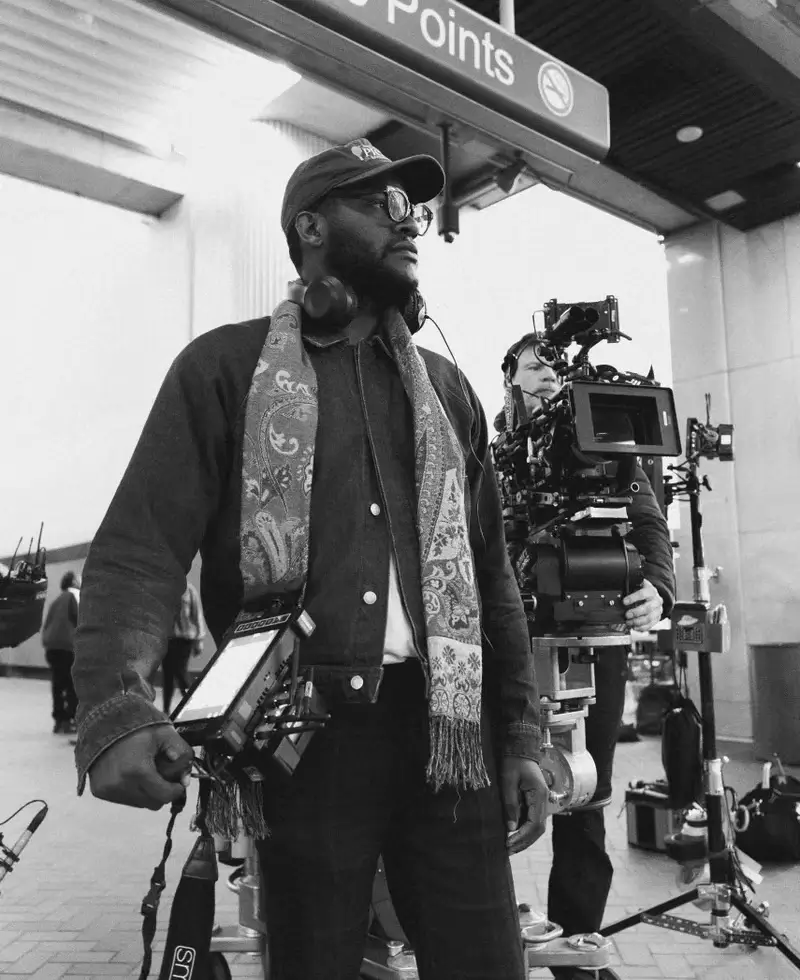
To get his feature directorial debut made, DAVID FORTUNE sought out organizations that could provide life-changing support for a filmmaker — and won. As the recipient of multiple fellowships and grants, including a $1 million grant from the AT&T Untold Stories Awards, Fortune was able to bring his Atlanta-set drama COLOR BOOK to life.
In addition to the AT&T grant, Fortune was a winner of the Netflix-Ghetto Film School Content Creator program, a Netflix-Film Independent Amplifier Fellow, a participant in the Village Roadshow Emerging Talent Program and the Paramount ViewFinders Directors Program, and was named one of Variety’s 10 Directors to Watch and MovieMaker Magazine’s 25 Screenwriters to Watch. Prior to Color Book, Fortune helmed the award-winning shorts Us and Shoebox.
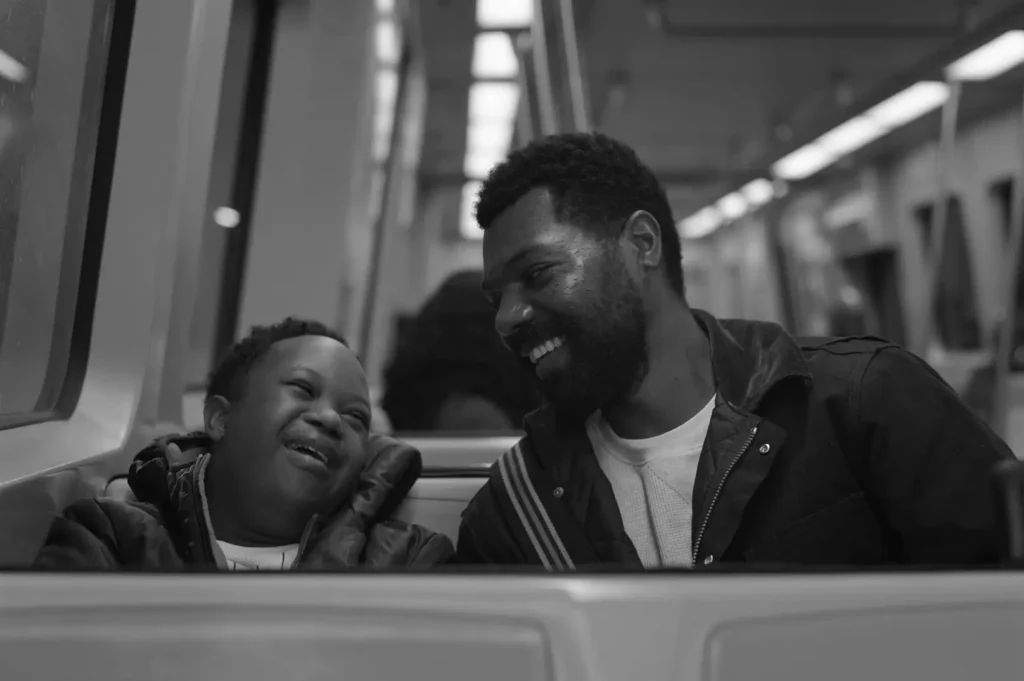
Color Book stars William Catlett as a recent widower and father of a son with Down syndrome (newcomer Jeremiah Daniels), who ventures through the city to take his son to his first baseball game. After premiering at the 2024 Tribeca Film Festival, Color Book went on to screen at festivals including AFI Fest (where it was a SAGindie-sponsored screening), Austin Film Festival (Best Narrative Feature Award winner), Chicago International Film Festival (Audience Choice Award winner), and Palm Springs International Film Festival (Directors to Watch Award winner). Fortune also received a 2025 NAACP Image Awards nomination for Outstanding Breakthrough Creative.
Color Book will release worldwide on Netflix on June 19, just in time for Father’s Day Weekend in the U.S. We spoke with writer/director David Fortune about the filmmaking journey of his feature debut.
__
COLIN McCORMACK: Where did the initial inspiration for the screenplay come from?
DAVID FORTUNE: It came from this feeling of wanting to see more Black father-son stories. I really wanted to see a human representation of what that looks like in cinema. At the time, I wasn’t seeing enough of it. I’m a big proponent that if there’s something you want to see, it’s up to you as an artist to put your foot down and go make it. That was a challenge to myself, If you want to see a Black father-son story, put the pencil to paper and start writing, and write the truth that comes with it.
As it pertains to the Down syndrome angle, I worked as a camp counselor for teenagers with Down syndrome, and I thought that could be an intimate human story that we haven’t really seen. Before truly diving into that narrative, I spent time speaking with parents who raised children who had Down syndrome and hearing their voices, their struggles, their joys, their pains, and their triumphs to make sure I was able to portray this as honestly as possible. It really came from their voice because I didn’t want it to reflect my own.
CM: You got a lot of fellowships and grants from different organizations that helped move the film forward, including Netflix, AT&T, Ghetto Film School, and Film Independent. In addition to the financing aspect, what other support did those organizations offer, either with this film or your career overall?
DF: The biggest support really came through the Netflix-Film Independent Amplifier Fellowship. That was the first program that accepted my film and the screenplay, and they helped nurture and develop the story so it could be ready to be made. When I first submitted it to the fellowship, I was a draft-and-a-half in, so it was still a baby. And literally three months after that, it got accepted into the AT&T Untold Stories program to be pitched. We won that in June, and next thing you know, we had to make a film in less than a year. It was a year’s turnaround from the time we got into the fellowship with Netflix and Film Independent to when we got funding to actually make it.
CM: A story like this is going to hinge so much on the lead actors. Could you talk about the process of finding William Catlet and Jeremiah Daniels?
DF: Will Catlet, I honestly had my eye on for a very long time. He was actually in the lookbook I created for the film. So, I always saw him as Lucky from day one. So when he agreed to be a part of the film, it felt like a natural fit. I was looking for a five-tool actor who could give me joy, pain, anger, fear, and give me love and tenderness. When you ask for that, you’re pretty much asking for a perfect actor. But Will, he was the right actor for this film, and it was seamless.
With Jeremiah, it took longer than I expected. When we first put out the casting call, we assumed that this role was going to change any kid’s life. But we found that not many people applied for the role. It was due to the fact that many parents don’t feel as comfortable putting their child in the arts because, one, they don’t see enough representation, and two, there’s been a history of misrepresentation in the depiction of individuals with Down syndrome. That caused a lot of fear and hesitation, so we didn’t get many applications. We were able to find Jeremiah through his cousin, who felt like he might be good for the role. He submitted and came in for a virtual audition, and he smiled and lit up the room. We all started smiling after he started smiling.
The next thing we did was bring him in for an in-person audition with Will Catlet for a chemistry read. After we did the chemistry read, I called Will into the next room, and I asked him, “Hey, what do you think about Jeremiah?” I promise you, Colin, he looked me dead in my eyes and said, “That’s my son. You could cast who you want to cast, but that’s my son.” And from there on, their collaboration and chemistry were seamless.
CM: I was going to ask if you had the luxury of time or money for rehearsals between the two because their chemistry was so good.
DF: No, we didn’t. We had one day of rehearsal, and the scenes that we rehearsed that day got cut out of the script. Nothing that we see in the film was ever rehearsed. How I approached directing them was just to allow them time to bond and exist. So, pulling back the camera and not being so forward with it, and letting them be within the scene. I said, “Let’s approach it as a documentary and just observe and capture their moment as it is.” They took the script, and they improvised, but still leaned into the emotion that I was requiring.
CM: With having any child actor on set, there are certain accommodations that need to be made. I was wondering if there were other accommodations to be made for Jeremiah in particular or for other people with disabilities on set. Were there any organizations that you could lean on for guidance on how to make sure that that set was the best experience and environment for him?
DF: Yes, we definitely collaborated with organizations to make sure that we provided an accessible set. We collaborated with SHOWability, which is a disability-focused organization that concentrates on individuals who want to be a part of the arts. We collaborated with the Down Syndrome Association of Atlanta, because we also wanted to make sure that any community-based organizations could help out, specifically with Down syndrome. And we also collaborated with the Black Family Connection, which is a disability organization that focuses on Black families. So, we wanted to have the full spectrum of support for this movie and make sure that we provided the most intimate and accessible set and production possible.
There were fine details like understanding who Jeremiah is and what his needs are, because every child with Down syndrome is not the same, and every child has different needs that might support them. With Jeremiah, it was small things, like him requiring a white tent versus a black tent, because of his eyes and his vision, to make sure it kept him up. It was just those small details that we needed to hone in on to make sure that he had a beautiful time in production.
CM: How many production days did the shoot have?
DF: We had 24 shooting days and one pickup day. So, 25 days total.
CM: As Atlanta has become such a big production hub over the last 20 years, it has often had to double as either a different city or as a generic “anytown” city. What was your approach going in, where you were making a film in Atlanta, playing itself, getting to represent your vision of the city?
DF: With shooting in Atlanta, I took a huge responsibility in how it was going to be portrayed for the world to experience, because a lot of production companies come and shoot in Atlanta, but the story is never about Atlanta. For me, that was something that I took personally, and I wanted to make it clear that this is the city of Atlanta. This is our story. This is the community that’s involved, and this is how we carry ourselves. That was a responsibility I was proud to have taken on. So, I wanted to make sure that each and every detail about our city was portrayed honestly and with a sense of humanity. Even to the details in how we compose certain framings of landmarks, and the small details of fences and streetlights and homes. We wanted to pay tribute and love to those small details of our city as well, not just the larger landmarks.
CM: In terms of the collaborators on the crew, were you pulling from a pool of people you’d worked with before, or was it a lot of new people?
DF: It was a lot of new people on this production, because I’m used to working in Los Angeles. Even though I was raised in Atlanta pretty much my entire life and I went to college here at Morehouse, I went to film school at Loyola Marymount University, and I stayed in LA for eight years. That’s where I made the bulk of my movies. When I moved back home, I knew I wanted to make Color Book in Atlanta, my city, a place I felt was true to me. It was a new form of collaborators. However, we knew our city, we knew our culture, we knew the essence of the city of Atlanta, so it felt natural to make it with this group of people, versus bringing people from LA.
CM: Was shooting in black-and-white a part of creating that vision of the city as well?
DF: Shooting black-and-white, the focus is more about character than landscape. I really wanted the audience to have an experience where they connect to these two individuals, Lucky and Mason, and they bond with them. They go on a journey with them. They feel their fears, they feel their tension, but they also feel their love for one another. I felt like black-and-white helps quiet your focus in connecting with these individuals and their relationship, rather than focusing on the backdrop. Whether it’s a blue sky or a passing red car or a blue or red home, I didn’t want your eyes going outside of these characters that I wanted you to fall in love with. Black-and-white helped accentuate that relationship a bit more.
CM: You premiered the film in New York, and you’ve screened it all over, but how special was it when you got to do the Atlanta Film Festival hometown screening?
DF: Doing the Atlanta premiere was so moving. I’m used to stepping out in front and giving opening statements before my film shows, and I never get nervous. It’s a part of the job as a director. You stand up, you represent your movie, you speak on behalf of the cast and the crew and everyone working on it. But I remember when I stood up to introduce the film in Atlanta, it was the first time that I felt like my legs started to turn into noodles. I remember not feeling like I would be able to speak because it was such an emotional moment.
I made this film as a gift to the community. How I shot it with every intention and love of our cities, our blocks, our people, was a gift to our community and our space. For me, it wasn’t about what I was receiving in that moment, but what I was giving. And that moment was so overwhelming. I don’t even think I sat in to watch the movie because I was so nervous. It meant a lot that it was received well by our city and is still being championed by our city. As a director, that’s all I could ask for, honestly.
CM: Looking back on this as your feature debut, is there a moment or shoot day or scene that stands out as a really special memory of this journey?
DF: It’s a lot to sift through. I think about the scene where Mason and Lucky are arguing on the train platform, and Lucky bends down to Mason, and he asks him what’s wrong. And Mason delivers the line, “I miss my mommy.” I think about Jeremiah Daniels and how he showed up for that scene, because that’s a very difficult scene to pull off. Forget him having Down syndrome, just as a child to tap into those emotions and to perform it and deliver that line with so much authenticity and truth.
CM: Now that the film is about to be available to the Netflix audience, what’s next for you? What are you excited about?
DF: I’m so excited for the world to finally experience this movie. We went on a journey, taking this film from city to city, from festival to festival, but now that the world will have access to it through Netflix, it means so much to not just me, but our team who made this film as a labor of love. It means so much to also know that people get to see a reflection of themselves, no matter what part of the world they’re in. This film speaks to the human truth of grief, love, and connection. No matter what race, what ethnicity, what language you speak, or what part of the world you’re from, you can connect to those human emotions and those universal truths.

__
Thanks to David for talking to us about COLOR BOOK. Learn more and watch the film on Netflix.
This interview has been edited for clarity.
If you’re an independent filmmaker or know of an independent film-related topic we should write about, email blogadmin@sagindie.org for consideration.