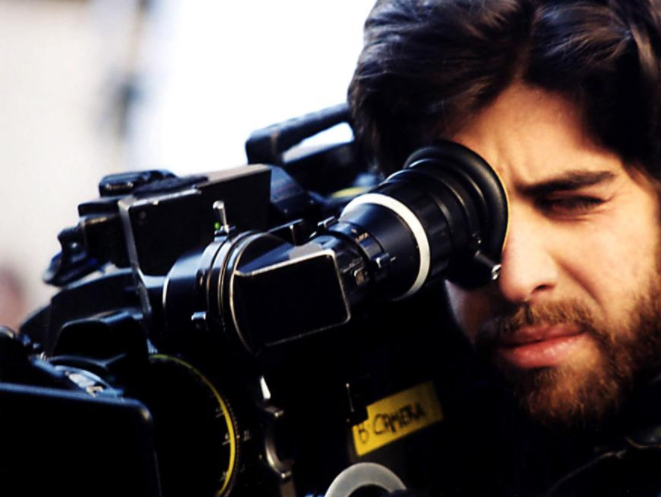
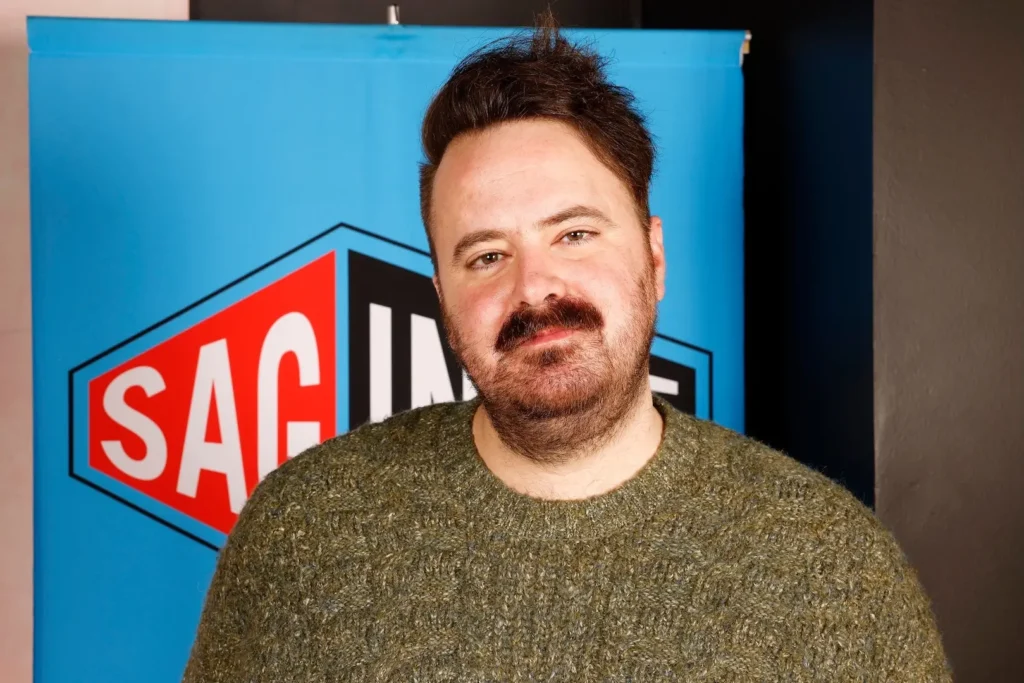
For playwright-turned-filmmaker ADDISON HEIMANN, major inspiration has come from anime, comics, scary movies, and queer cinema. In his 2022 directorial debut, Hypochondriac, he explored mental illness through the prism of horror. Now, for Heimann’s follow-up film, the sci-fi horror-comedy TOUCH ME, he re-visits those prior influences while also paying homage to the stylistic Japanese films of the 1960s and ’70s.
Touch Me finds codependent roommates Joey (Olivia Taylor Dudley) and Craig (Jordan Gavaris) in need of a place to crash. The besties make their way to the mansion of Joey’s mysterious ex-boyfriend, a tracksuit-wearing, hip-hop-dancing space alien named Brian (Lou Taylor Pucci). Brian’s otherworldly allure and healing touch sets the friends against each other and into a grotesque battle for survival. Marlene Forte and Paget Brewster co-star in the film, which is executive-produced by Justin Benson and Aaron Moorhead.
After premiering at the 2025 Sundance Film Festival (where Addison co-hosted SAGindie’s annual Filmmakers Luncheon), Touch Me went on to screen at SXSW, Overlook Film Festival, Frameline San Francisco LGBTQ+ Film Festival, and Brooklyn Horror Film Festival. It also screened internationally at festivals in Australia, Austria, Canada, Finland, Poland, Sweden, and Switzerland.
Yellow Veil Pictures will release Touch Me theatrically in New York on March 20, before expanding to additional cities on March 27. The film arrives on digital platforms and On Demand on April 2. We spoke with the film’s writer, director, and producer Addison Heimann about making a movie about aliens, mental illness, sex, and tentacles.
__
COLIN McCORMACK: I’ve heard you mention the idea for this film came from “a place of astounding depression.” When you were processing and working through that with a screenplay, what were the first elements that started to click into place?
ADDISON HEIMANN: The first thing I have to talk about is The Untamed, because it’s such a profound influence on this film. I watched it and thought, I really would love it if a tentacle monster could fuck me and remove all of my depression. Infinity Pool was a huge inspiration as well, with those beautiful, hybridized, crazy rainbow sex scenes. I happened to be doing a deep dive into ’60s and ’70s Japanese exploitation films, called pink films. Very colorful, very theatrical, stylized movies, such as Lady Snowblood, House, and Female Prisoner.
So, I took my broken heart and was like, I want to fuck an alien, and I also want to tell a story about what it’s like to live with obsessive-compulsive disorder. And it just turns out that marrying the two creates the weird tentacle sex baby that is Touch Me. That’s how we started, then I went from there and realized I had to explain to everybody what the fuck that means.
CM: How did you take it from something on paper to something that you needed to become a reality with money and other people involved?
AH: I remember telling my executive producer, “We’re going to have three aspect ratios.” And he’s like, “Why?” I explained it, and he said, “I don’t get it, but I trust you.” It was a lot of that at first. But it was my fault. When you’re making something so profoundly not within the zeitgeist, you have to do a lot of prep work to get people to see your vision. Fortunately, when you have such a specific idea, it’s very easy to see the yeses and very easy to see the nos. There’s no midway, “I don’t know if I’m on board.” You either are a freak like me, or you’re not. It was not simple by any means, because Lord knows this was a beast to put together, but when you find one freak, all of a sudden the freak train starts happening. Then, you’re like in the end scene of Us, with all the people in red jumpsuits holding hands. All the freaks in control of the world.
The movie gets made by finding the people who give you the courage to say exactly what you want to say without watering it down. And while I still had the opportunity to have final cut and tell movies in this budget space, everybody said, “You should do this.” Even when I was on set and was questioning myself, people were like, “No, remember your vision.” I was able to communicate and have every other freak at the top of their game execute their freakiness with me. Thus, we created the wacky, sad, tender, strange, and beautiful world.

CM: In terms of building that world and doing the prep work to get everybody on board, when having those first conversations with your DP and production designer, did you show them a lookbook or movie references? How did you get everyone on the same page?
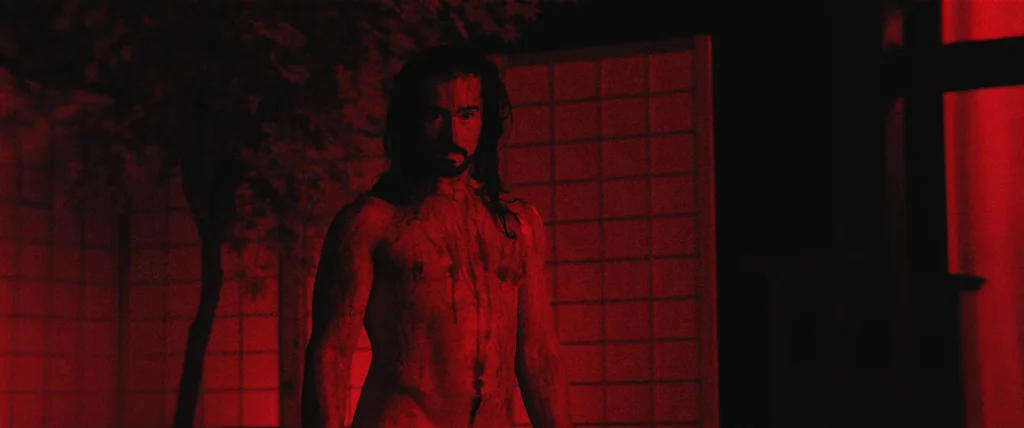
AH: Oh yeah, we absolutely had a lookbook. You have to for this movie. Otherwise, people are going to be like, “We don’t have a hundred million dollars to create an alien effect.” Fortunately, I’d worked with Dustin Supencheck, my cinematographer, who is a beautiful, incredible, calm presence on set. I told him my ideas — wanting to go monochromatic color for a lot of scenes — and gave him my film references. We would watch movies together, and he was excited. We were trying to choose an aspect ratio, and he was the one to say, “I think we do both.” Because they’re in two worlds, the outside world and the alien world. A lot of movies from the ’60s and ’70s were shot in CinemaScope. It was all about getting the close-up shot of the eyes, and in CinemaScope, it’s just so delicious.
With my production designer, Steph [Reese], it was heavily predicated on Mishima: A Life in Four Chapters, the Paul Schrader movie, where Eiko Ishioka designed these beautifully ornate, theatrical sets that tell a story within a story. I showed her that movie so she’d understand that it’s a representational idea and we’re telling a theatrical story. And in its theatricality and its tactility, the reality shines through. Those initial conversations allowed everybody to get on the same page, and then they took it from there and made it better than I could have ever imagined.
CM: You have characters that are somewhat based on yourself, and you also have this enigmatic, sexy alien man. That’s a lot to cover, even with a fairly small cast. How did you go through that journey to find the perfect actors?
AH: Well, you get a lot of Nos. You get a lot of What the fucks. You get a lot of Absolutely not interested in a million years. But then — kind of like the answer earlier — you find the freaks.
Everybody came in in a different way. Marlene, who plays Laura, was in my first movie [Hypochondriac], so it was an easy thing to say, “By the way, I wrote this for you.” And she was down. Her main source of acting is playing everybody’s Latina auntie on every TV show, which is wonderful, but I knew what she can do in theatre, as a founder of the Labyrinth [Theater Company]. I was like, “Honey, I want to give you the world.” Jordan, who plays Craig, is actually the husband of one of the main actors in my first movie, and I’d been a big fan of his on Orphan Black.
Lou is an interesting one because he, ironically, had no problems with the freaky alien stuff. He just really wanted to know that I knew the science fiction. So, we sat down, ate wings, and I explained to him specifically how Brian works, science fiction-wise. Olivia and I bonded because we both have obsessive-compulsive disorder. We didn’t even talk about the movie; she just understood it. That’s the beautiful thing about it, it’s universal. So, we talked about that for a while, and once we were two hours into our conversation, I offered her the movie right there. I didn’t need to see anything else, I knew that she was the one.
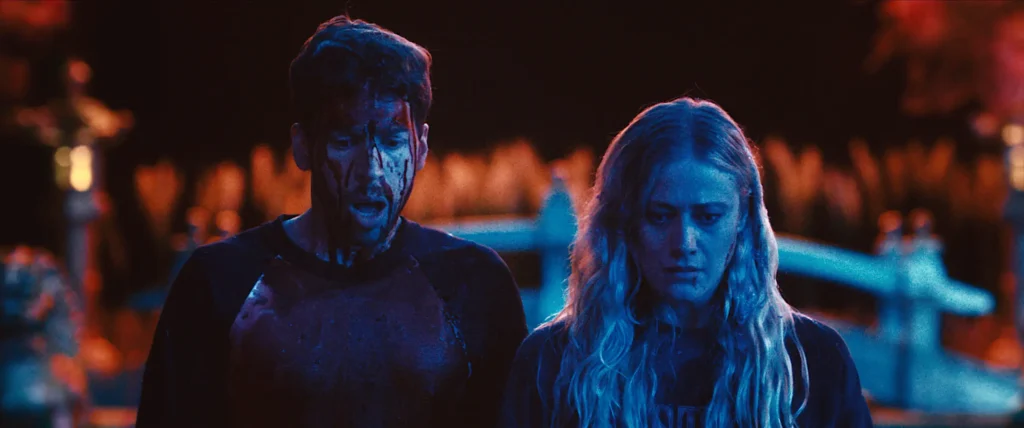
CM: Did you have either the time or the budget to allow for rehearsals to help that cast chemistry click?
AH: Of course not! Oh my God, you’re so cute thinking that we had money. It was a complete happy accident, or I’m just really good at casting, and honestly, it’s probably the former. Olivia was on another project. Jordan lives in Canada. Lou was getting ripped and doing hip-hop dancing. Everybody was kind of separate, then we got together for the read-through. And it was like, Oh good, they did the work for me. I was very clear, “Let me be the goofy one. You be the real ones.” So, when I got to the edit to shape the tone of it, they kept their feet on the ground and told a real story.
Fortunately, the movie rests on Olivia and Jordan for that beating heart. It’s funny, because I didn’t even think they were that likable when I wrote the movie, but seeing them performing it, and adding this level of empathy, that is a real reason the movie succeeds. I’m not even surprised, because they’re such phenomenal actors that they were able to pick up this real, incredible chemistry from the get-go. That created the bedrock foundation for the rest of the movie.
CM: In getting this team together, you have intimacy coordinators, puppeteers, all these jobs that aren’t on every film set. Was this your first experience building as vast a team as you needed for this project?
AH: Yes, definitely. I worked with intimacy coordinators before, and I love them. For me, I like having all those conversations upfront, so we know what’s there in the playground, we know what toys we can play with, and we know what’s off-limits. Once you know that and you’re on set, then all you do is play. You can call an audible, sure, and if people are uncomfortable, we have that protection. But mostly it’s about making things sexier. I can do so much, but somebody whose literal job is to know how to create intimacy and make things feel authentic and wild and erotic, then thank God. Then, of course, having effects and stunts on top of all that, and having to build a set, everybody needs to be firing on all cylinders.
What I’ve learned is that when you don’t have a lot of time, the best thing you can do is draw really good stick figures. Create a shot list with your beautiful stick figures. The more specific you can get upfront, the easier it is for everybody else to fully understand. Specifically with the pivotal sex scene, I completely storyboarded it. Olivia and Lou knew exactly what they were going to show, Josh [Russell] and Sierra [Spence] on our effects team knew exactly what they were going to design, and our stunt coordination team knew exactly what they were going to do to make sure Olivia was safe being lifted in the air while being less than clothed and also wrapped in tentacles.
By the time we got to that day, we had built the foundation. It was all there. Now, we just have to build the house, and it’s so much easier to build the house when there’s a foundation. While it was a really long day, it was also a really gratifying day because there’s nothing more beautiful than seeing something work so fluidly because you put in the prep work.
CM: Speaking of houses and foundations, the literal house in the film is such a pivotal location. How was that search?
AH: It was so lucky. The indie film Gods were just waiting to give us that gift because we’d searched. There are hundreds, if not multiple hundreds, of houses in LA that are funky and weird. A lot of them were outside of what’s called “the Zone”, which means we would have to house people or pay them a premium and go into overtime. And a lot of the houses were fine, but they weren’t really hitting. Then, just north of Burbank, a 20-minute drive from everybody’s house, is this flying saucer of a motherfucker. It was owned and designed by the kindest people you’ve ever met, who are just getting into using their house for film productions.
The house had everything. We walked in — my cinematographer, my producers [John Humber and David Lawson Jr.], and I — and we were like, “Yep.” It even had curved walls. My cinematographer hates bathrooms because they’re so small. We walk in, and it’s the biggest bathroom you’ve ever seen in your life. Everything about this house was so fascinating and so well-designed. Then, without even realizing it, when we do the drone shot, we see that it fucking looks like a flying saucer. Thank the indie Gods because it was very nerve-wracking trying to find that house. We knew all of the production design money was going to have to go into set-building. Then we were able to find something that was already kind of a set, and we could just dress on top of it. I’m so grateful for that.
CM: We talked about the filming of the special effects and sex scenes. But in terms of cutting it, what is that process like? You hear a lot about what it’s like on the set, but then you have to cut around the effects, the makeup, the stunts, the intimacy.
AH: I worked with a wonderful editor, my friend Jess Weber, who I’ve known for ten years, and we’ve always wanted to work together. We started by having a movie club every Tuesday before we shot. I showed her all of my inspirations, so by the time we got to the end, Jess was coming up with ideas that I didn’t even think of, especially when you get into those more fantastical scenes. I’m very much like, This is how I want it to feel. This is how I want it to look. But I can’t go into Premiere and edit it myself, so a lot of the heavy lifting was done by her. Everybody knows that when you make a movie, and you see that first edit, you want to kill yourself. It is the worst thing you could ever imagine. Fortunately, that’s the worst the movie is ever going to be. But in that edit, there were some very beautifully creative editing choices that came through our conversations in our movie club.
A very specific thing that I didn’t know we were going to use was from the first week. It was built to be a lighter first week to get everybody into it. Part of the reason Joey and Craig’s relationship works really well is that we shot all of that first act in sequential order at my house. One day, we had three hours to wait for nighttime, which is insane. So I had these three hours, and I was just like, “We should set up a photo studio room.” We shifted colors and shot at a high frame rate to get slow-motion, intimate transitional interstitial scenes. And I didn’t know what we would use them for. “Here, Jess. Here are hours of slow-motion body rolls.” [Laughs] We were able to turn that into these metaphorical, sensual, transition moments that really aided the look of it. Jess is so good that she was able to synthesize the vision that I was coming to and then add so many more of her own ideas and thoughts on top of it. It was a very seamless process from shooting to editing.
CM: I noticed at the end, you have the “A film by” credit, which usually lists just the director’s name. But, you have it lead into the credits for everybody. I was curious about what the thought process was behind that.
AH: I come from theatre. I did not go to film school. I found directing purely accidentally when I wrote a script about my mental breakdown, which my producers felt that I should direct because I was the only person who could actually recreate my own brain. Every time I’ve made something, whether it be film or theatre or anything, you start to notice that the best way to exist on a set is to pick the best idea in the room. More often than not, it’s not me. My job as a director is to steer the ship and communicate effectively what I want things to feel and look like. But I don’t hold the camera, I don’t know what lens to switch to, I don’t know how to design something. That’s why you hire the best people who know what the fuck they’re doing.
Together, there is a collective groupthink that is a movie. So, the thought that I made “a film by” me, is essentially ludicrous, because there is a piece of every single member of the crew there, from the PAs to the producers to the executive producers to all my department heads. Some of the best ideas came from my grip or a PA. The way I make movies is very collaborative, and I like the credits to reflect that. So, it’s a film by us.

__
Thanks to Addison for talking to us about TOUCH ME. Find out more info about the film at touchmemovie.com.
This interview has been edited for clarity.
If you’re an independent filmmaker or know of an independent film-related topic we should write about, email blogadmin@sagindie.org for consideration.