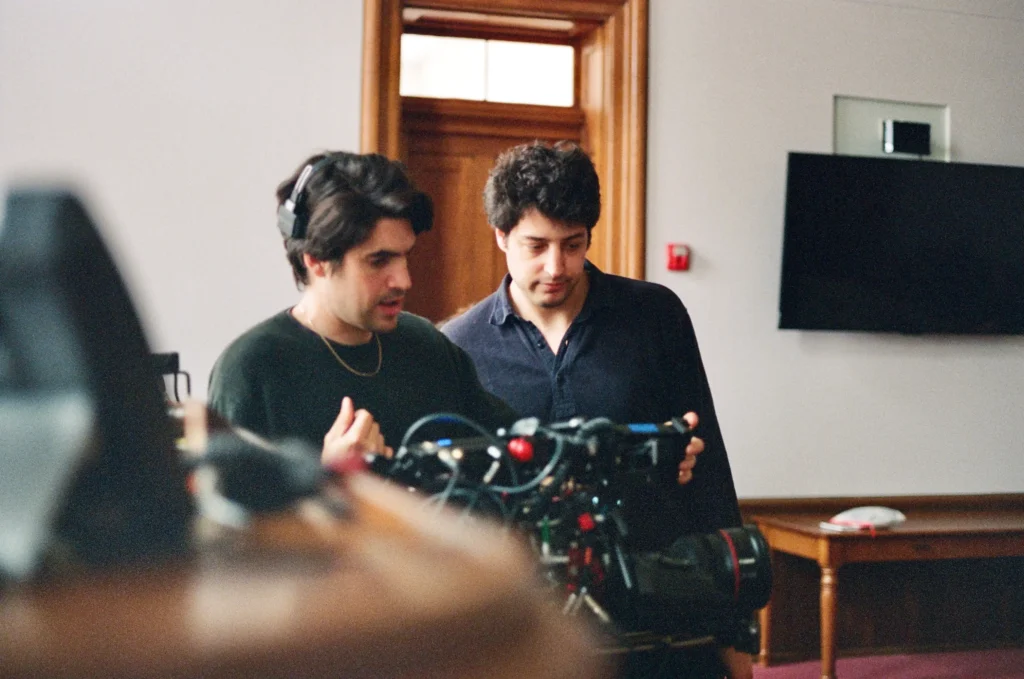
UNION COUNTY began life as a short film set amid the opioid crisis in rural Ohio, a community that filmmaker ADAM MEEKS returned to after graduating from NYU’s Tisch School of the Arts. Meeks’s 2020 short premiered at the Berlin International Film Festival and went on to be featured in Le Cinéma Club, Short of the Week, NoBudge, and as a Vimeo Staff Pick. Following his short film’s success and career development through the Jacob Burns Film Center Fellowship, Yaddo Residency, and Film Independent Screenwriting Lab, Meeks revisited the subject matter of Union County by expanding it into his debut feature film.
The feature version of Union County follows Cody (Will Poulter) as he enters a court-mandated drug rehabilitation program. Noah Centineo co-stars in the film, along with numerous real-life participants of Bellefontaine, Ohio’s 2025 Adult Recovery Court, including chemical dependency counselor Annette Deao playing a version of herself. Union County premiered at the 2026 Sundance Film Festival before being acquired for distribution by Oscilloscope Laboratories.
On the heels of an Ohio screening tour, Union County opens in theaters on August 14. We spoke with the film’s writer and director, Adam Meeks, about bringing this new version of the story to fruition, working with the Ohio recovery court, and reuniting Poulter and Centineo (both producers on the film) on screen.
__
COLIN McCORMACK: How are you?
ADAM MEEKS: I’m doing good. I’m currently in a hotel in Cleveland. I’m based in Brooklyn, typically.
CM: You’re in Ohio for a screening?
AM: Yes. In the lead-up to our theatrical release, we’ve been doing an Ohio tour of the movie, hitting a lot of amazing theaters and communities here in a different city each day for five or six days. It’s been awesome so far; sold-out screenings and really thoughtful, beautiful Q&As. It’s the best-case scenario of what I pictured when we were making it, and what I hoped to be able to do. So, it’s been awesome to get to do it.
CM: Speaking of being in Ohio, when you moved back to Union County after college, were you going there specifically seeking out inspiration for a potential film project, or was that just a happy accident that you stumbled upon?
AM: When I first started coming back, it was because my grandmother was getting older, and then she eventually passed away. I stayed for a while to spend time with her and then with the family. During that time, I started to see a lot of folks who were close to me and my family struggling with addiction. For the first time as an adult, I was starting to form my own relationship with the place that I’m from originally. It was always a place that I’d taken for granted and had moved away from when I was young. So, I was sort of falling in love with the place for the first time, and I started to think about how I could write something that could be meaningful, even locally, at a community level.
My uncle sent me this book by Sam Quinones, Dreamland, that does an amazing job outlining the causes, effects, and impacts of the opioid epidemic, specifically in Ohio and the Midwest. That gave me a great context and made me feel even more energized to tell a story, broadly speaking, in this world. Then I was introduced by my uncle to the drug court judge, who invited me to sit in on a meeting. That’s when I realized that this recovery community is a beautiful light in the dark. It is a community-based thing of people showing up for each other, and it’s a remarkably successful program and infrastructure. It provided an alternate narrative to so much of what I was seeing and hearing about the epidemic. I thought if we could translate the feeling in this courtroom to the screen, and observe people getting back on their feet, hopefully that can be a meaningful addition to the cultural conversation around addiction and recovery.
CM: You started with a short film. Were you thinking maybe this could be a feature during that process?
AM: It came about later. I was in the edit on the short. I had been through the process of making it, which allowed for a lot of beautiful relationship-building in the community. Emerging on the other side and seeing it start to take shape, I started to feel like I had unfinished business in the community and with this story. The short film premiered in Berlin a week or two before the pandemic fully locked everything down. Suddenly, I had a lot of time to write and think about what the story might look like on a larger canvas. It started to emerge pretty organically from there. I would fly from Brooklyn to Ohio and spend time there, and allow specific people, relationships, and stories to inform the script. I was able to do it in a way that felt patient and thorough, by letting stuff emerge and then figuring out the form to hold the things that resonated with me.
CM: Were you able to use the completed short film as an additional sizzle reel or selling point when trying to get the feature going?
AM: Totally. And I think the fact that it had premiered at Berlin was really helpful. It kind of showed that there was an audience for the film and the subject matter. We figured out a lot when making the short about how to make something in this more fluid, hybrid way, overlapping between fiction and nonfiction. I could point to the short and say, “This is the starting point for what this will look and feel like.” I think it would have been really hard for me to set out to make a proof-of-concept, but I was really fortunate that by the time I had the feature script, I already had this pre-existing proof-of-concept.
CM: It’s one thing to have a government entity helping you with research or inspiration, but it’s another thing to have them buy in and participate in the making of the film. How did you start those first conversations with the recovery court to have them be such a big part of the project?
AM: Annette is such a trusted and respected voice in the community that it really started with her. She opened so many doors and was a champion very early on. Also, I was just around a lot over a period of a few years. At a certain point, I remember asking the judge [Kevin P. Braig] if I could come by one day, and he said, “You know you’ve got an open door policy. You can come by anytime.” It was cool to feel like we’d reached that point in my relationship with a judge in this court.
Then, it was going through the bureaucratic steps to get permission from the county commissioners and make sure that everybody felt like they understood what we were doing and why, and that we would be respectful of their processes. A big part of it came from Annette’s and the judge’s buy-in, and them being able to vouch for us and affirm for folks who were worried that we would not impose on their work in the program. It was a lot of that relationship-building and time spent. And then, designing a specific process of shooting the movie that would let them continue to do their jobs.
CM: So people who appeared on-camera as themselves were always part of it because that’s the way you could be least obtrusive of their routines?
AM: We were able to be in the space with cameras, but we didn’t ask anything else from the participants of the program. It was just about, Can we observe this in a documentary capacity, and have our two lead actors in character in the room as well? You can treat them like other folks in your program, and the film will be better if you do. That was the starting point. Then, Annette and the judge became the axis with which we were able to move between the fiction and the nonfiction, because they were also comfortable performing some scripted moments for us. We did that separately. There are a lot of little moments that were performed by Annette and the judge and some others that we would do afterwards without everybody else there. I never asked any of the participants in the program to act, and I never gave them direction. It was just an invitation to represent themselves and tell their stories in the way that they do every Monday when they’re interacting with the judge.
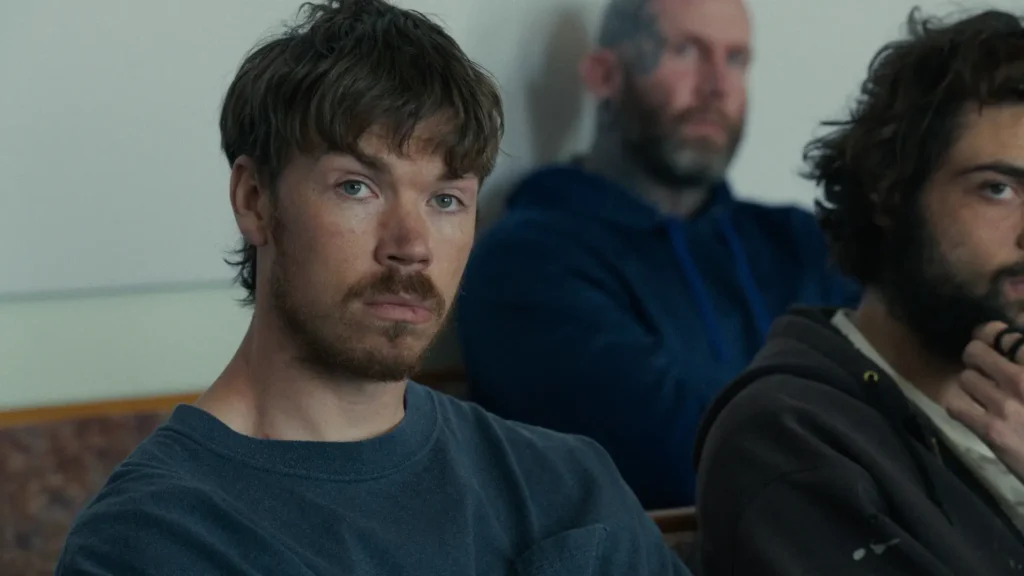
CM: Could you talk about the process of casting the professional actors? I’m sure this kind of production was a unique opportunity that doesn’t come around very often for most actors.
AM: I was meeting with actors and thinking about the best way to approach it, and I actually met with Will and Noah the same week. We’d been able to get the script to their agents at WME, and I think it had resonated with them. I met with Noah first, and I just loved him as a person. He had a huge heart for the story, and he had just put his production company [Arkhum Productions] together. He really wanted to figure out how he could help us make it in whatever capacity, whether that meant him having a role in it or not, which he told me from the start. But I did recognize in him many aspects of the Jack character, and felt like, depending on who Cody was, he could really be exciting as Jack.
A couple of days later, I met with Will, and within ten minutes of talking to him, it solidified for me. I felt an immediate, fundamental connection with him over why we wanted to make this and how we wanted to do it. He was instantly a real collaborative partner. He had made Dopesick a couple of years earlier and had a lot of knowledge of the subject matter, and I think he was excited by the chance to represent a different side of it, the recovery side.
It really came together when I learned how much Will and Noah already loved each other after having made Warfare together. They had this pre-existing brotherly dynamic. Noah actually told me when I called him to talk about the idea of him and Will doing this, “This is so exciting because I think about Will like an older brother in my real life at this point.” So, for both of them, the chance to do that and build off their friendship and working relationship was also really exciting and was pre-baked in a way.
I knew that, as much as we were bringing in real folks and experiences and processes, that kind of pre-existing relationship when playing foster brothers is the kind of thing that couldn’t be fully faked if we could avoid it. Having that from the jump would really go a long way, hopefully. I can’t imagine having done it with anybody else, both in terms of the way that they embody their characters and also the process of doing it with them. They were the best partners at every stage, and continue to be. Will’s driving around in an SUV with us right now, going city to city in Ohio. They’re the best.
CM: Did the schedule allow for them to come early, since you were so embedded in the community? Was it important for them to get there and get a sense of the place?
AM: Yeah, I had hoped that would happen, and to their credit, they initiated that as well. They really wanted that as part of their process. So, six months out, they spent a chunk of time in the area with us, meeting folks and going to Annette’s house for dinner, and just hanging out and getting their feet under them locally. And for three or four weeks before the production, they got on the ground and used that time to slowly shift into their characters and make decisions, feel stuff out, observe, and fine-tune. It was really amazing to watch what can emerge when there’s that much commitment to a process and a real depth of exploration. I noticed with both of them a body language that started to shift. A character that was not Noah, and a character that was not Will, started to emerge out of the foundation of real relationships, a knowledge of the program, and a connection to certain parts of the place. So much of that came out of their commitment to spending time there and not taking any shortcuts in the process.
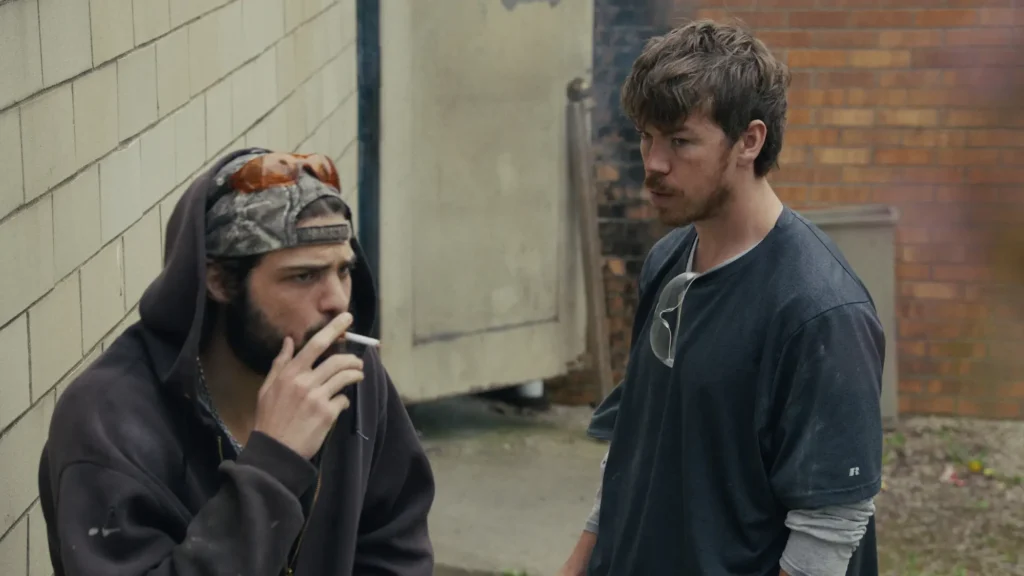
CM: While you were observing other people’s processes, how did you learn your own process as a director for working with professional actors versus people who were performing for the first time?
AM: So much of directing performances for me is about each person having their own unique process. The way that Will works is different than how Noah works, and it’s different than how Annette works. Annette was figuring out how she works in the same way that I was, and she had great actors to talk to and explore that with. So much for me was about becoming really close with the performers, and us talking about how we wanted to approach certain things and what our priorities were. Then it could be tailor-made in some ways on a scene-to-scene, moment-to-moment basis for these different performers.
A lot of times, Will was at his best in a first take. And then, Annette would really get going after a couple of warm-ups. So that meant I would shoot Will’s coverage first, and give Annette some opportunity to warm up and find a version of the scene that felt the most true to her lived experience and click into it. I had a specific sense of the person and their working process, and saw my job as somebody who helped them use their process to get to where we all wanted to get. So, I try not to be too prescriptive about how I want to work with the actors, especially when this is my first film. I tried to do whatever directorially I could to make people feel the most comfortable and present and locked into whatever the moment required.
CM: Outside of the cast, when you were building the rest of your team and your crew, were you relying on locals or bringing in people you knew from Brooklyn? How did you put together that production team?
AM: The majority of our department heads we brought in either from New York or LA. Our production designer, Juliana [Barreto], lives in Colorado but works at an extremely high level all around the world. I hired folks who I was a fan of, who I knew would do an amazing job, and who were also sensitive and joyful collaborators who would be as respectful of the community as I was. Then on the ground, they built out their teams from local Ohio and Midwestern crews. It ended up being a pretty substantial local crew of really amazing artists. That’s such a gift for folks coming in out of town, to feel like there are real roots and a community connection to this project. Hopefully, there was some hometown pride that everybody locally was able to contribute to.
From early on, we wanted this to feel additive to a place and not extractive. One of many ways that we wanted to do that was to hire as much locally as we could, and work with as many of the local restaurants and hotels and coffee shops, and just invite participation and contribution from everybody. It was so cool to see Noah form a friendship with the barista in town. And Will and Annette continue to text on a regular basis. That went beyond actors and was just as much a crew experience.
CM: Now you’re getting to revisit them all on this Ohio roadshow trip. How was that very first screening you did there?
AM: The first one was pretty quickly after Sundance, at Cleveland [International Film Festival]. That was amazing, a very warm and affirming reception. Then, what really stands out is the community premiere that we got to do, which was in this historic one-screen theater that’s directly across the street from the courthouse. We were able to sell out this theater, and it was our first chance to show the thing that we made to everybody locally who contributed to the movie, and celebrate that with everybody.
Actually, three or four folks in the movie who were in the program were set to graduate. That sort of set it up for us to hold their graduation at the theater before the film started. So, we got to celebrate their completion of this 18-month program and how well they’re doing, and then watch this film that they were a part of. It was so beautiful and moving and very special. Will even flew in literally for six hours to be there, see people again, and thank everybody. That was also a real standout local experience, and it set a tone for what a lot of these more local screenings have been. It’s been awesome.
CM: What’s next for you?
AM: I have a new script that I’m hoping we’ll get to make next that is a contemporary Western set in a part of Montana where I spent a lot of my upbringing. It’s got some shared DNA with Union County in terms of its socioeconomic interests and the way of looking closely at a place that is personal to me, and some issues that place might be contending with. If Union County is a grounded and meditative film, this one is a much more propulsive kind of rural crime thriller. It’s an exciting thing to step into next.

__
Thanks to Adam for talking to us about UNION COUNTY. Learn more about the film at unioncounty.oscilloscope.net.
This interview has been edited for length and clarity.
If you’re an independent filmmaker or know of an independent film-related topic we should write about, email blogadmin@sagindie.org for consideration.